HMHS BRITANNIC
KEA ISLAND
There is a moment on the descent when the line ahead of you disappears into darkness and you are falling through nothing but blue. The surface light thins. The water turns from turquoise to sapphire to a deep, cold indigo, and then, far below, a shape begins to resolve out of the gloom — vast, unmoving, impossibly long. You have read the numbers. You have seen the photographs. And still nothing prepares you for the instant the hull of the Britannic rises beneath you, stretching away into the dark in both directions, a sleeping leviathan draped in nearly a century of silence.
She is the largest intact passenger ship resting anywhere on the ocean floor — the forgotten sister of the Titanic. For more than a hundred years she has lain on her side in the Kea Channel of the Aegean, 120 meters down, remembered by few and reached by fewer. This is the story of that ship — how she was built for glory, remade for war, and lost in less than an hour — and the story of our own small expedition to meet her in the dark.
Built for Glory
The Britannic was the third and largest of the Olympic-class liners, the trio of giants with which the White Star Line meant to rule the North Atlantic. Her sisters were the Olympic and the ill-fated Titanic. Where rival companies chased raw speed, White Star chased something else — size, comfort and an almost imperial sense of grandeur. The Britannic was conceived as the crowning achievement of that ambition.
Her keel was laid at the Harland & Wolff shipyard in Belfast on 30 November 1911, on the same great gantry slip that had just released the Olympic. She was launched on 26 February 1914. At roughly 269 meters long and 48,158 gross tons, she was the most voluminous ship the line had ever built — grander inside than either of her sisters. She was even to carry a pipe organ built in Germany, intended for her first-class public rooms; it never sailed with her, and survives today in a Swiss museum, a small, strange relic of the life she was supposed to lead.
But the Britannic was born into the shadow of a catastrophe. On the night the Titanic went down in April 1912, the Britannic was still a skeleton of steel on the stocks, and the disaster rewrote her before she ever touched water. Her builders went back to the drawing board. A double hull was added along the length of her engine and boiler rooms. Her watertight bulkheads were carried much higher, several of them raised all the way to B deck so that she could stay afloat with six compartments flooded. And most visibly of all, she was fitted with a set of enormous gantry davits capable of launching far more lifeboats than her sisters had carried. Everything that had failed the Titanic, the Britannic was designed to survive. History, as it turned out, had other plans.
Transformed by war
The Britannic never carried a single fare-paying passenger. By the time she was ready, the world had changed. The First World War had broken out in the summer of 1914, and the luxury liner that was meant to glide between Southampton and New York was instead requisitioned by the Admiralty and remade for a grimmer purpose. In 1915 she was commissioned as His Majesty’s Hospital Ship Britannic.
Gone was the livery of a floating palace. Her hull was painted brilliant white, encircled by a broad green band and marked with three great red crosses so that she could be seen — and, by the conventions of war, spared — from a distance. Inside, the grand staircases and first-class lounges became wards and operating theatres; the promenade decks held rows of beds. Where champagne and string quartets had been planned, there were now surgeons, nurses and the wounded.
Her maiden voyage, on 23 December 1915, took her from Liverpool toward the eastern Mediterranean to bring home casualties from the Gallipoli and Salonika campaigns. Over the following year she made several such voyages, carrying thousands of sick and injured men back from the war. On 12 November 1916 she left Southampton on her sixth voyage to the Aegean. She would not return.
Lost in fifty-five minutes
The morning of 21 November 1916 was calm and bright. The Britannic was steaming through the Kea Channel, a few miles off the Greek island of Kea, when at around 08:12 a violent explosion tore into her bow on the starboard side. The cause has been argued over for a century, but the weight of evidence — chains and mine anchors later found on the seabed — points to a mine, part of a field laid in the channel weeks earlier by the German submarine U-73.
The damage was catastrophic and, crucially, worse than her clever design was meant to withstand. Watertight doors failed to seal properly, and the sea poured aft faster than anyone expected. Captain Charles Bartlett made a desperate gamble: rather than hold position, he drove the great ship toward Kea in the hope of running her aground in shallow water before she could founder. It was a brave decision, and it may have doomed her. Driving forward pushed water through open portholes that the nurses had opened to air the wards, and the list to starboard steadily worsened.
The cruelest chapter came at the lifeboats. With the ship still moving and her stern lifting, two boats were lowered on the port side without orders — and drifted straight into the Britannic’s enormous, still-turning propellers, which had risen partly out of the water as the bow went down. Both boats were destroyed. Nearly all of the thirty people who died that morning were lost in those few appalling seconds. Captain Bartlett stopped the engines moments before a third boat met the same fate.
The rest of the evacuation, remarkably, was a triumph. Of the 1,066 people aboard, more than a thousand got away safely in the ship’s ample lifeboats — the very improvement her designers had insisted upon after the Titanic. At 09:07, just fifty-five minutes after the explosion, the Britannic rolled onto her starboard side and slipped beneath the Aegean. She had been the largest ship lost in the entire war, and yet, in the shadow of her sister’s fourteen hundred dead, the world soon forgot her.
Silent for Sixty Years
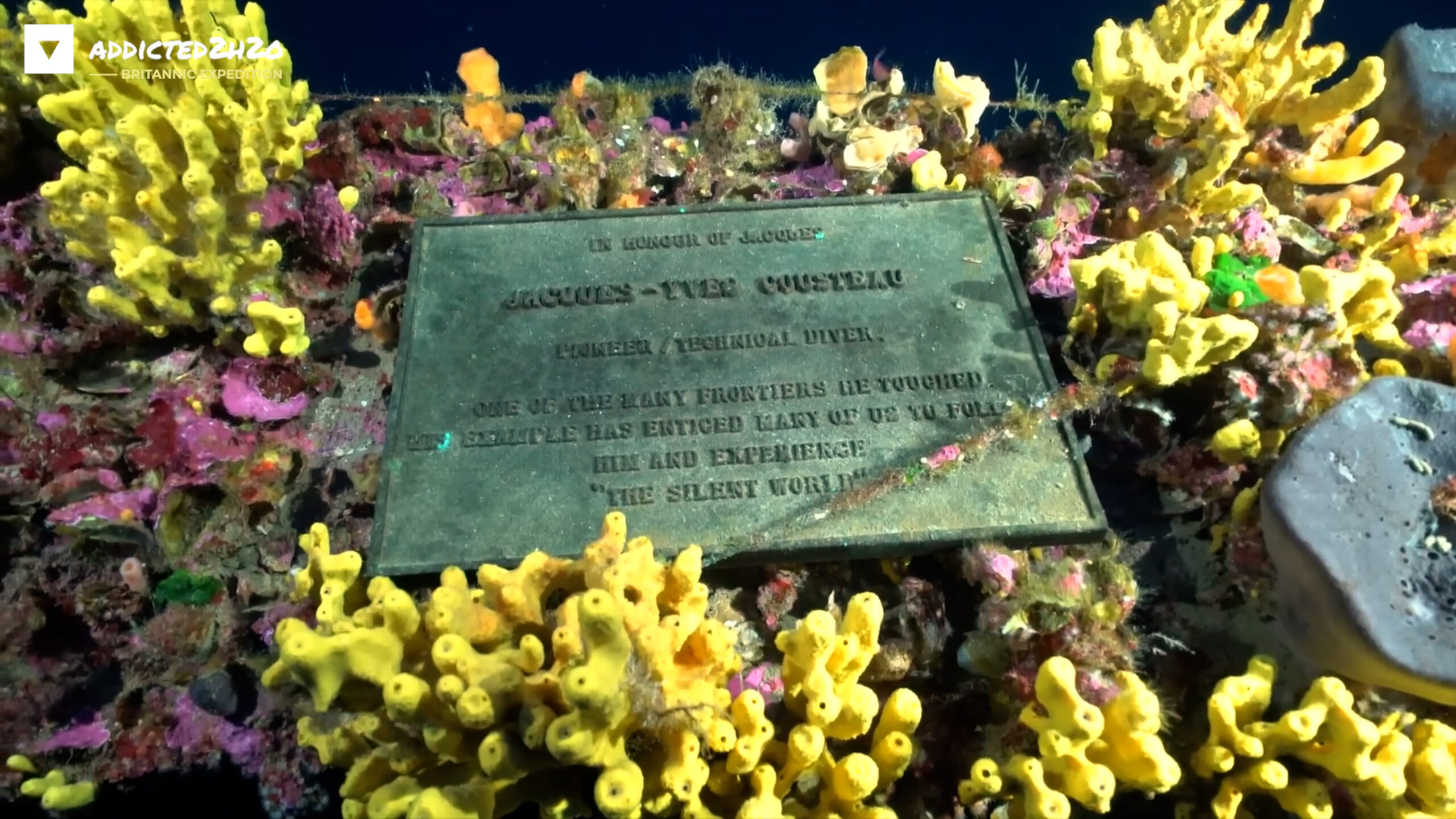
For almost six decades the Britannic lay undisturbed and unseen, a rumor on old charts. Then, in 1975, the French explorer Jacques-Yves Cousteau and the crew of the Calypso located her on the floor of the Kea Channel and became the first people to lay eyes on her since the morning she sank. Cousteau’s divers confirmed what the records suggested — an immense liner lying on her starboard side, substantially intact — and left a small bronze plaque on the wreck, which divers still pass today.
In the decades since, the Britannic has drawn a steady trickle of the most capable technical divers and expedition teams in the world. In 1996 the wreck was bought by the British maritime historian Simon Mills, who has written extensively about her and has carefully controlled access ever since, so that the site is studied and documented rather than stripped. Expeditions have filmed her for National Geographic, the BBC and others, mapped her interior and pieced together the final minutes of her sinking.
That privilege has carried a price. In 2009 the respected British diver Carl Spencer lost his life while filming the wreck — a sober reminder, never far from anyone’s mind down there, that the Britannic does not forgive carelessness. She is history, and she is also depth, cold and current, all at once.
The wreck today
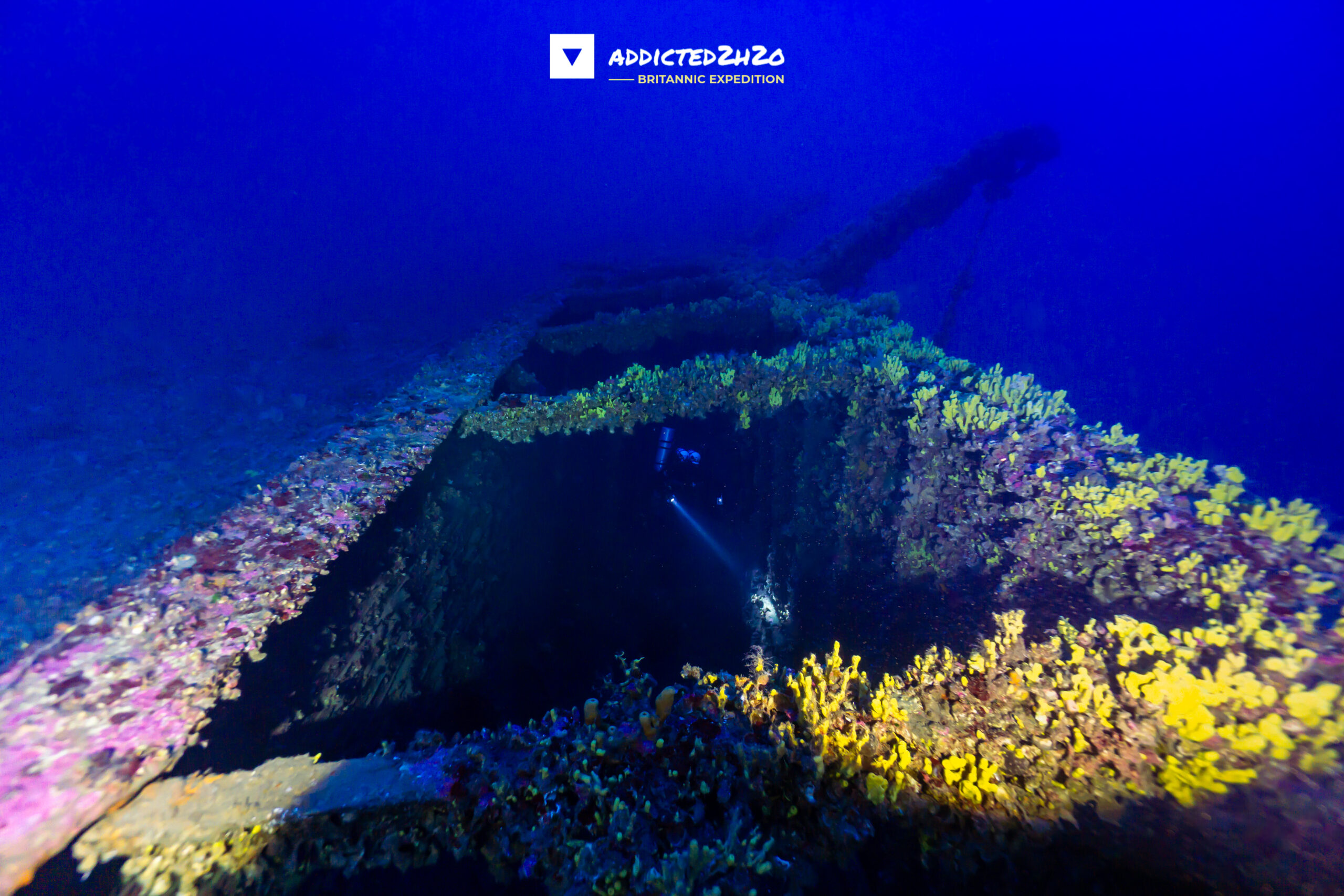
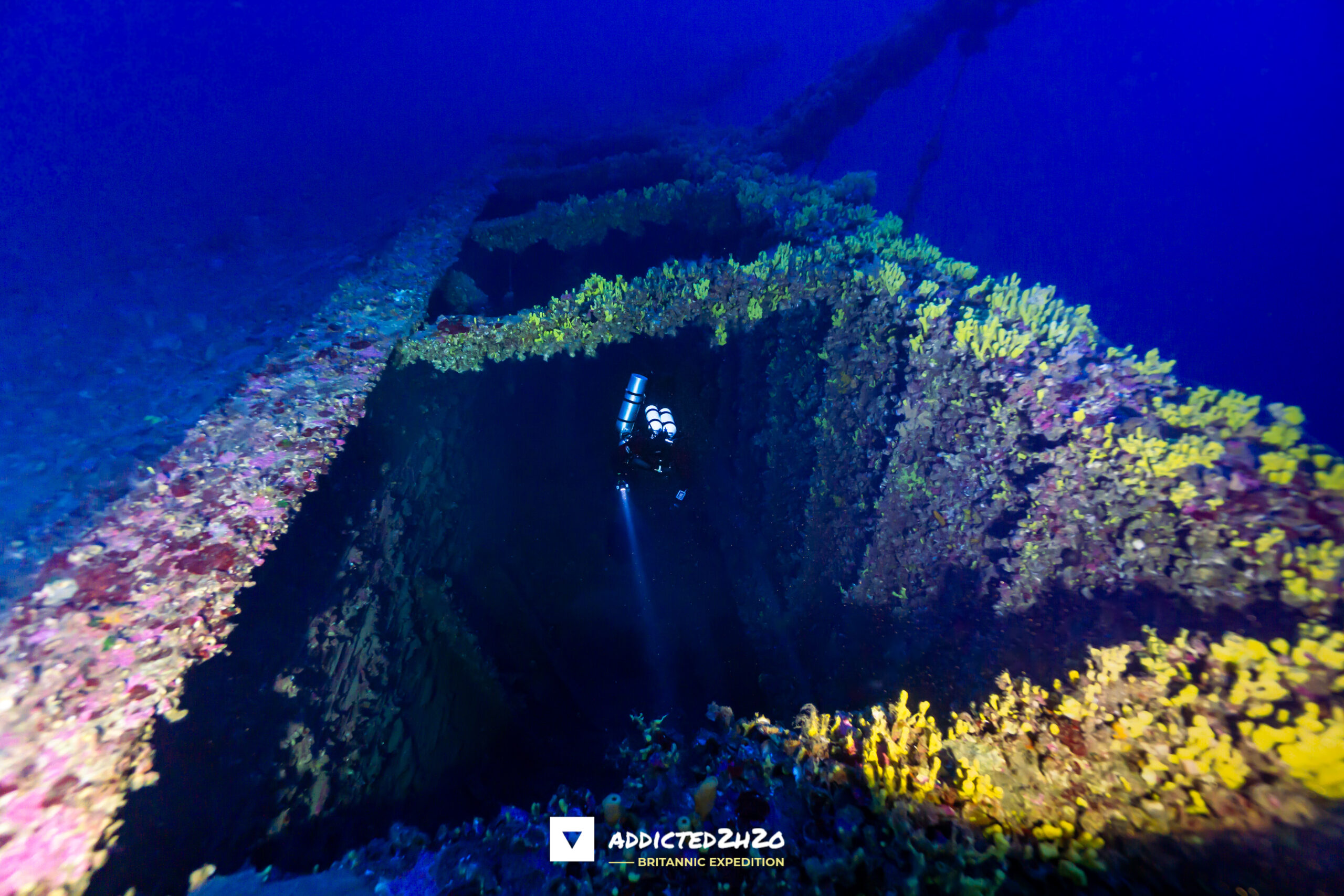
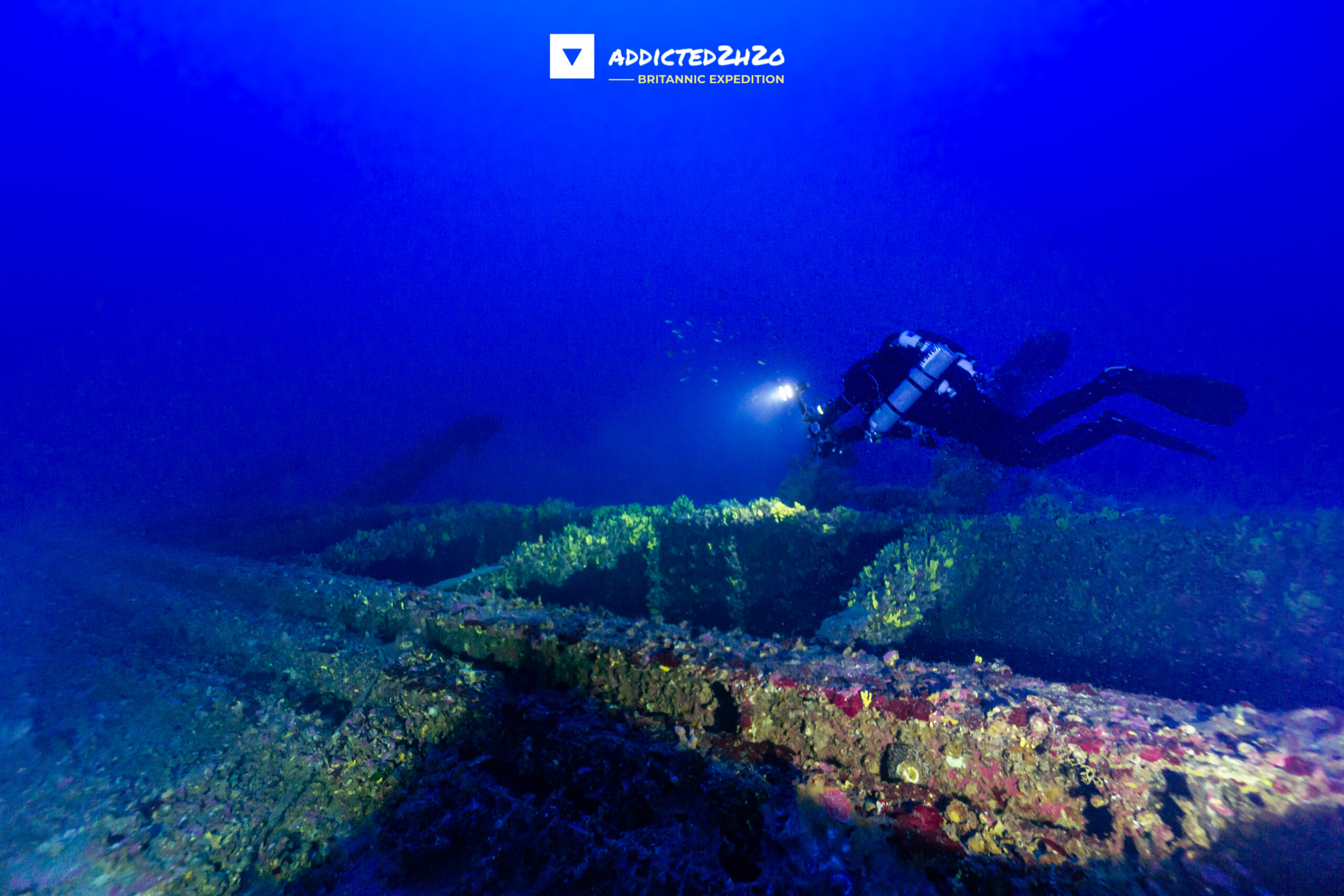
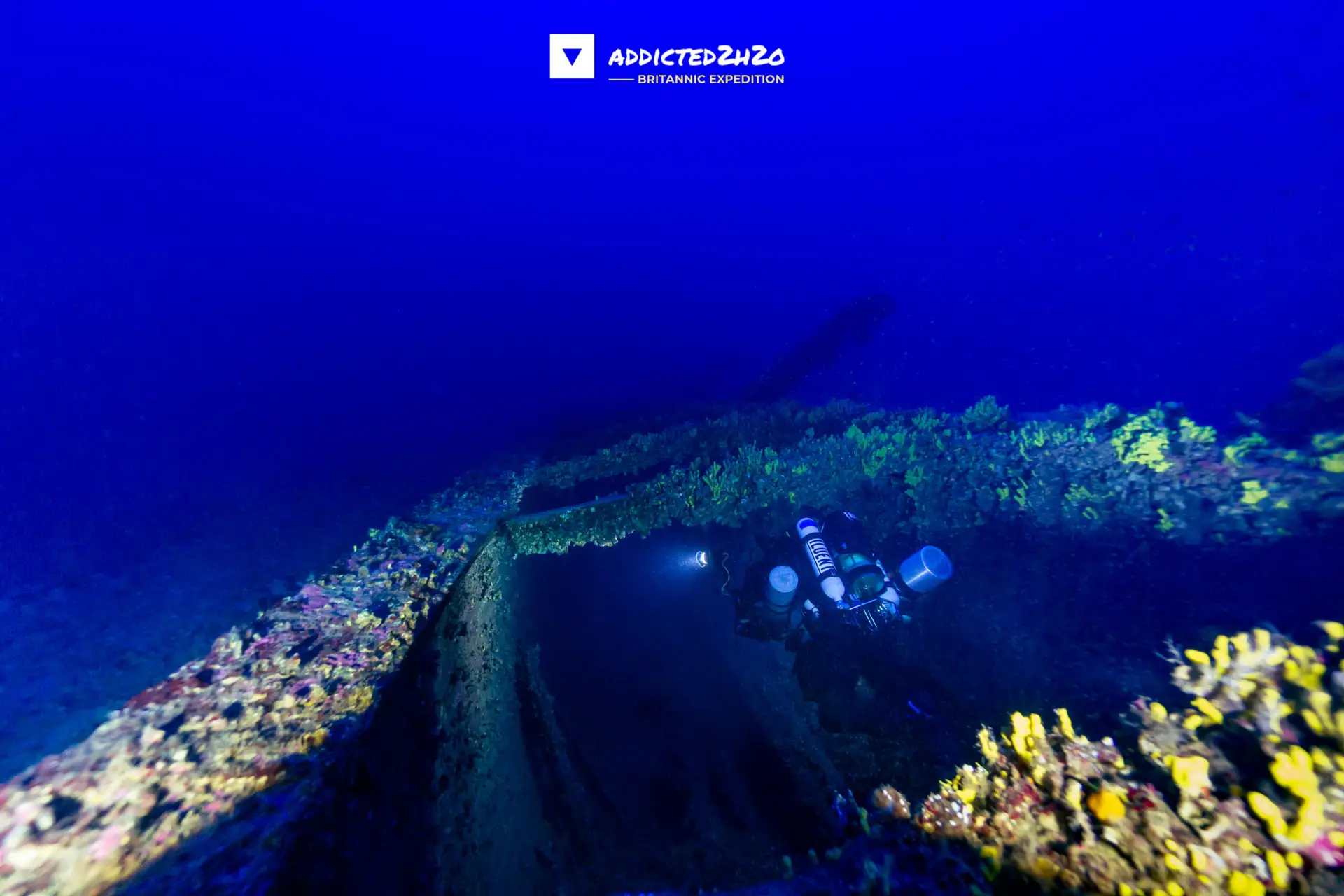
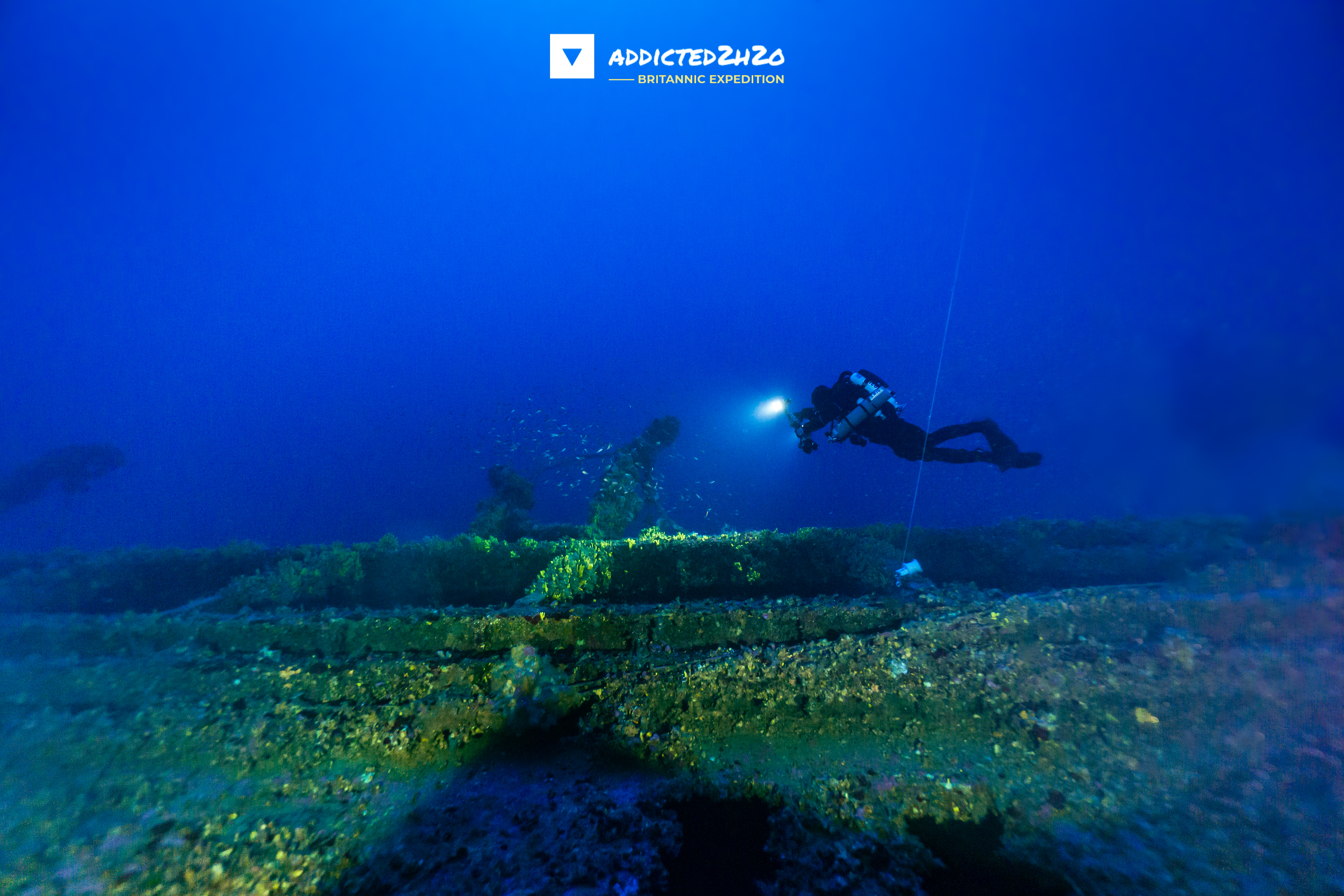
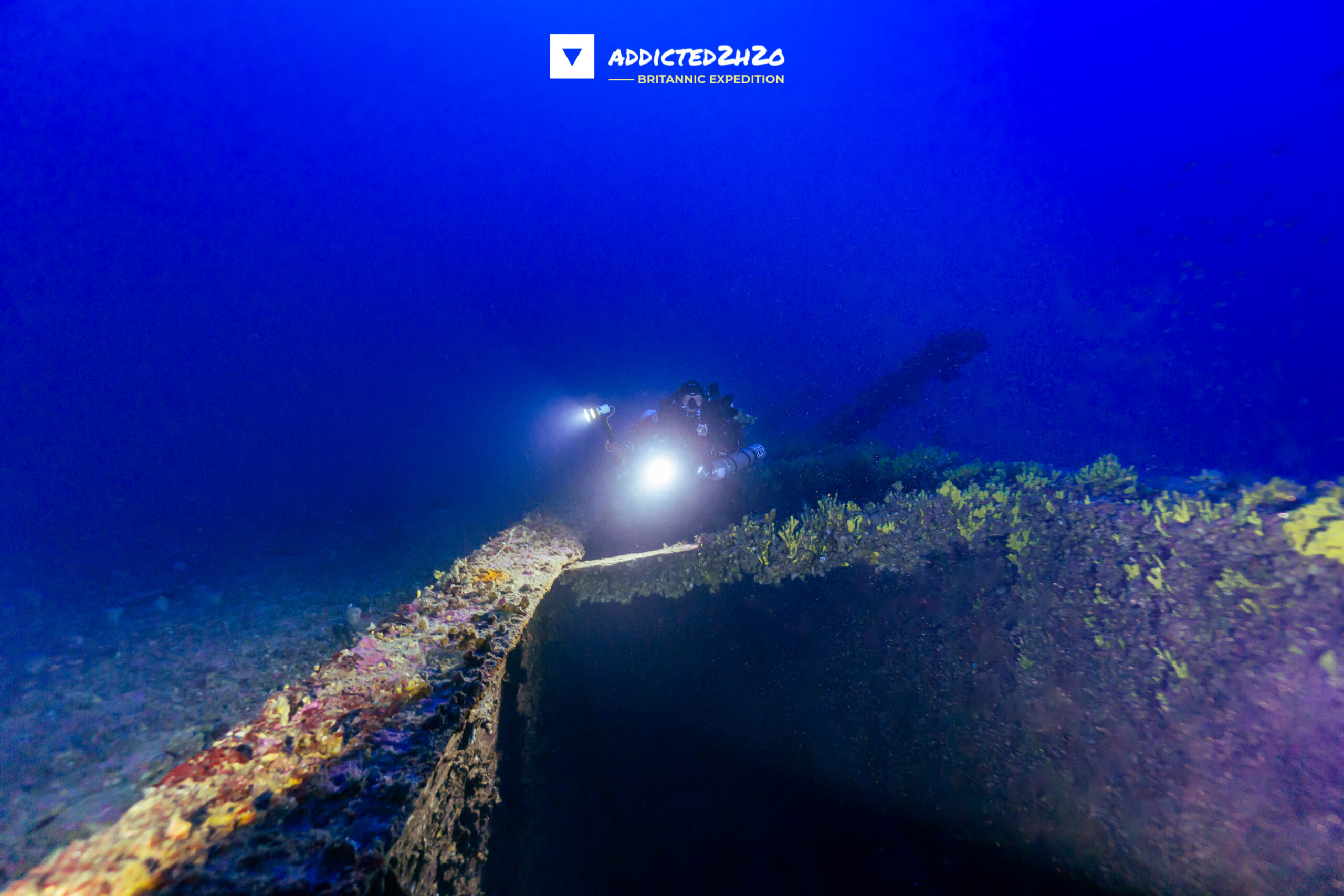
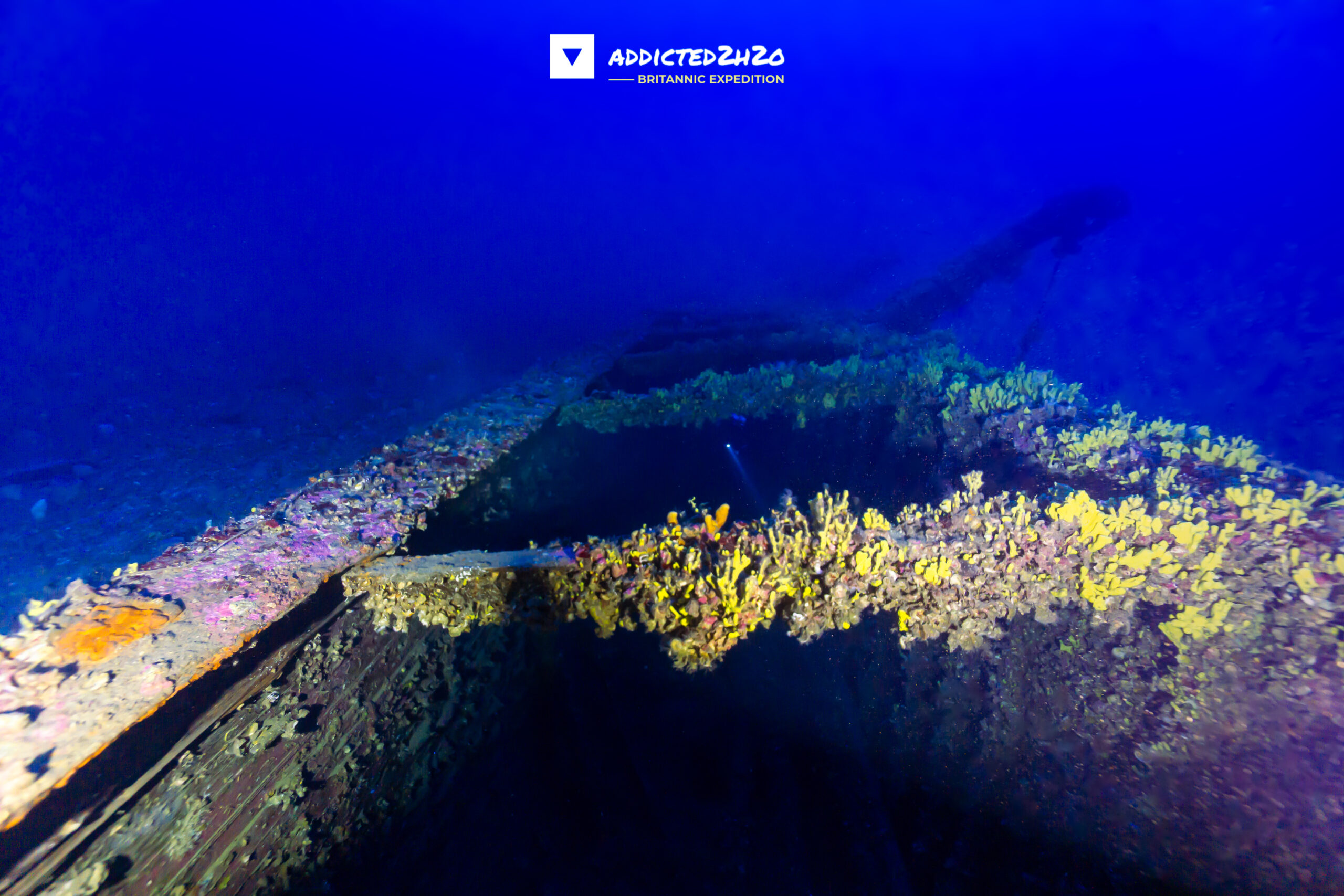
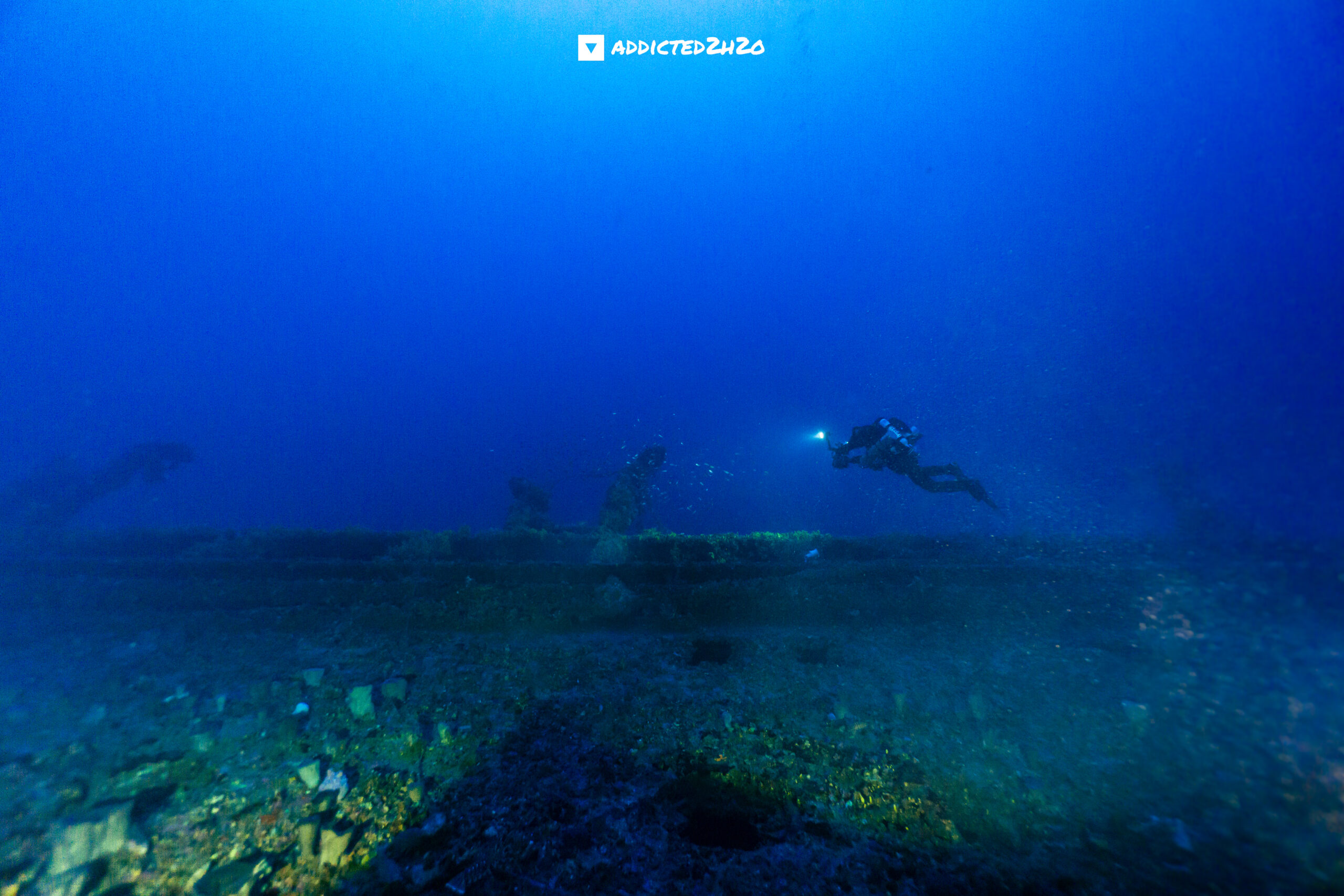
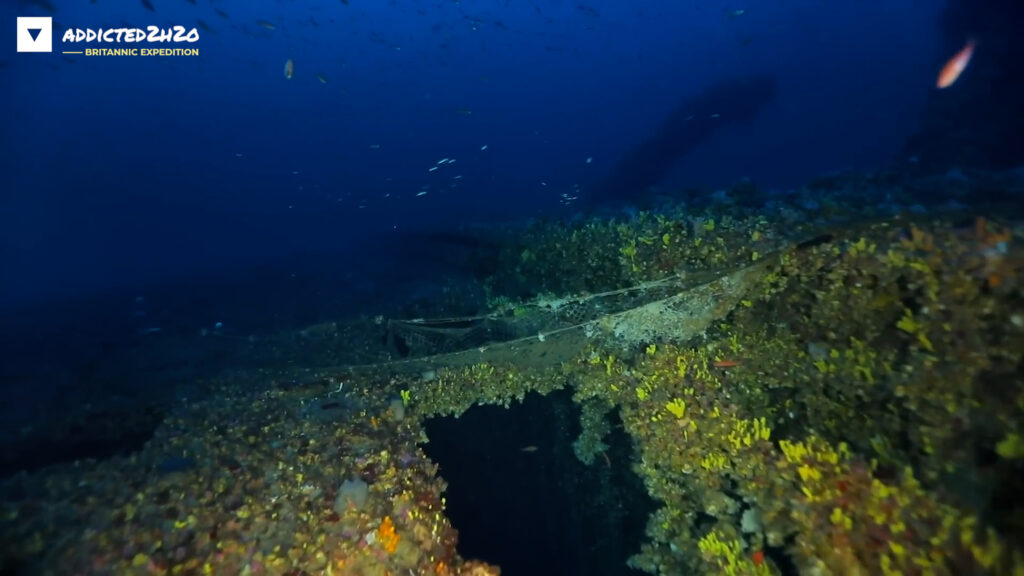
The Britannic rests on her starboard side at a depth of around 120 meters, her 269-metre hull running across the seabed — more than twice the depth of the water that holds her. She is astonishingly well preserved. One theory holds that her orientation protects her: the current sweeps across the exposed keel and is funneled away from the more delicate decks, so that the ship has aged more slowly than she had any right to. More than a century on, she is still unmistakably a ship, not a ruin.
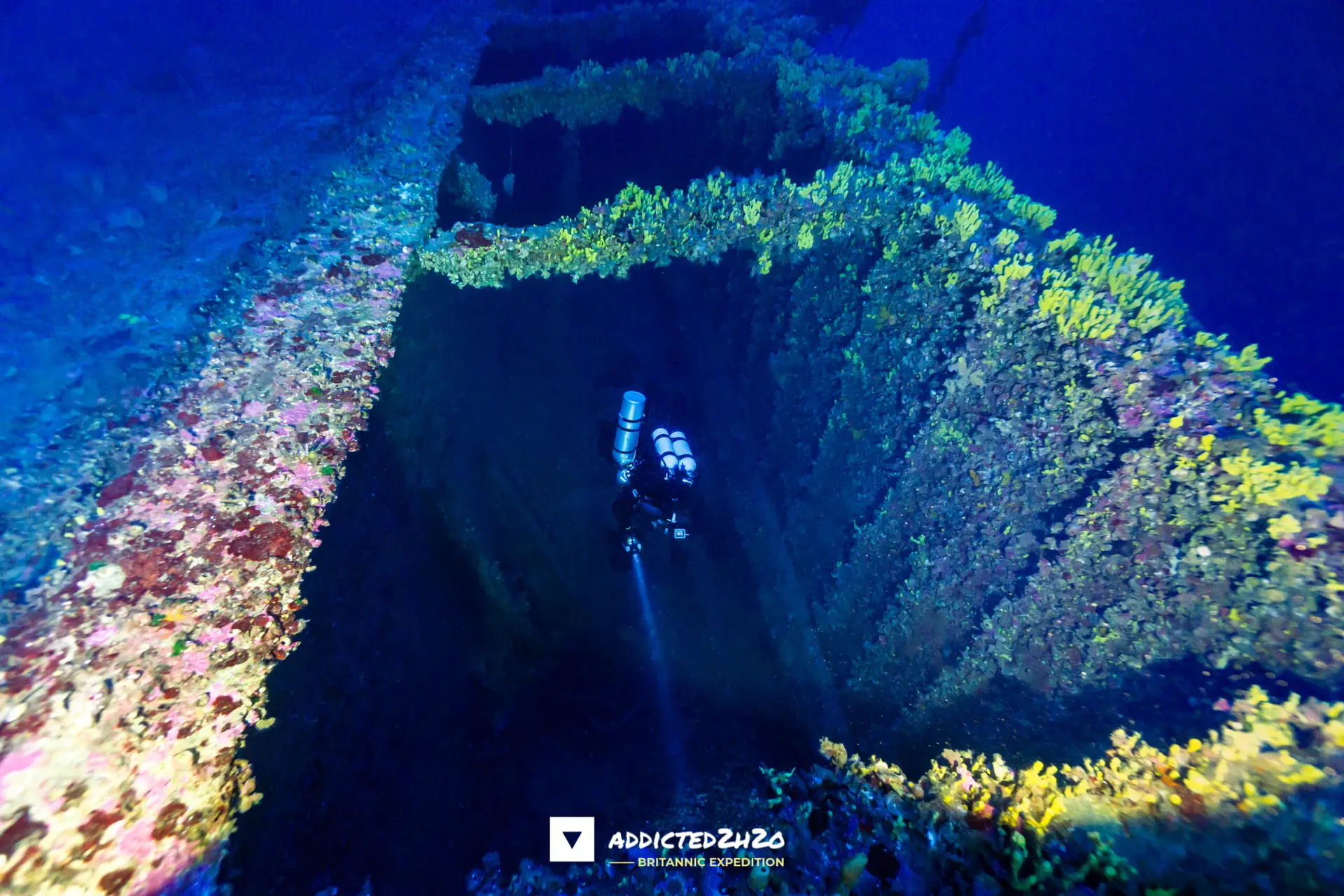
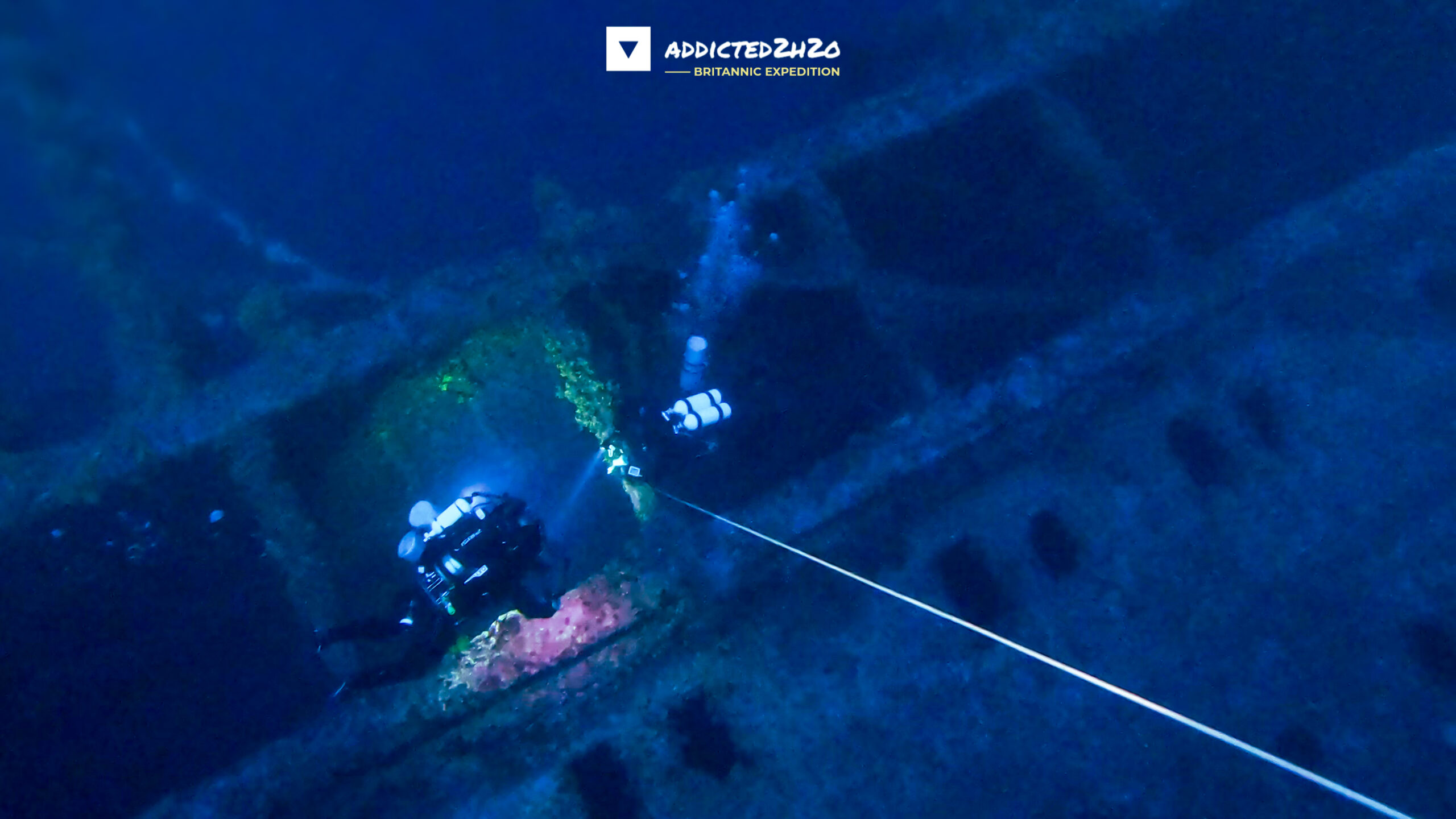
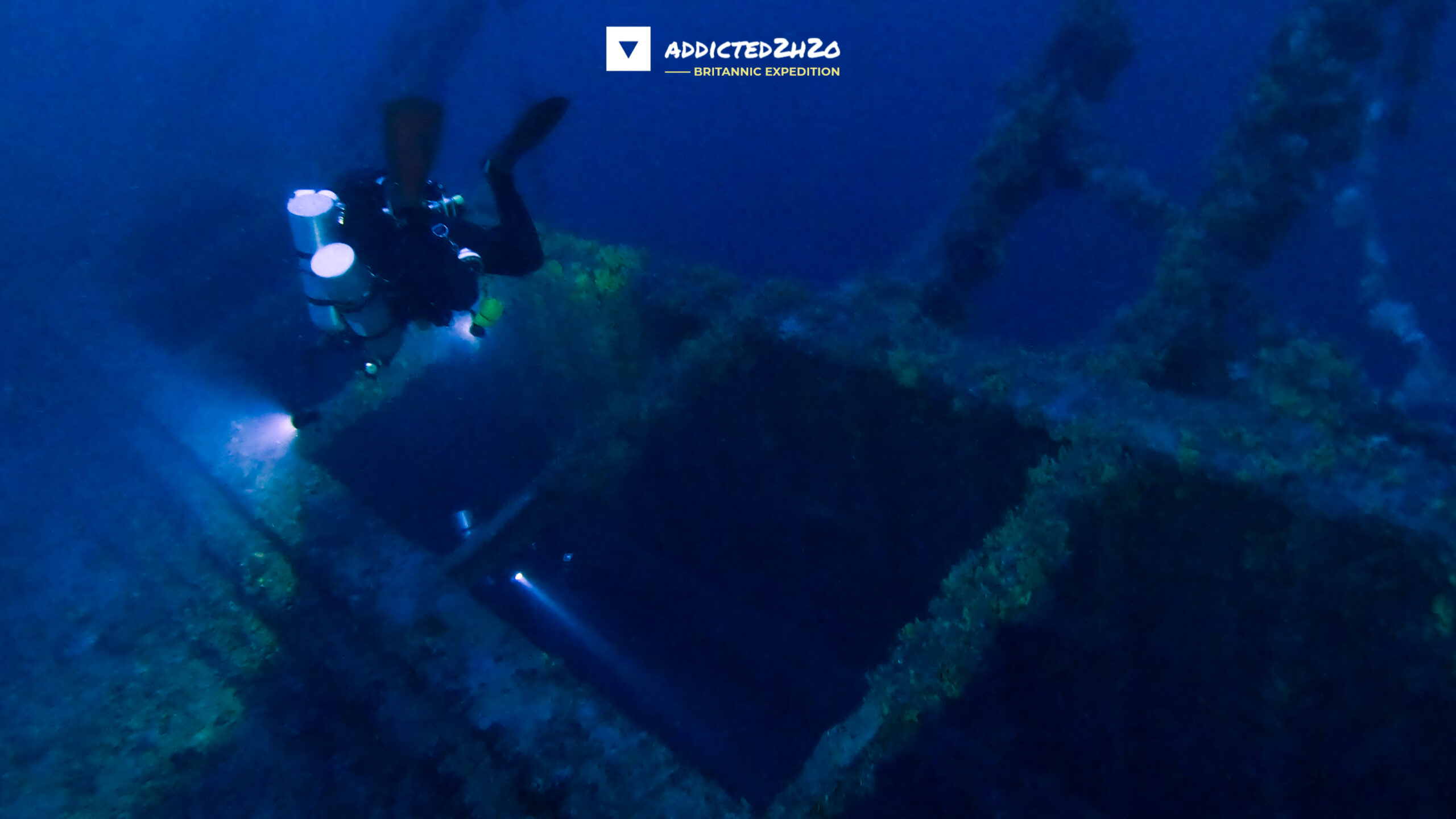
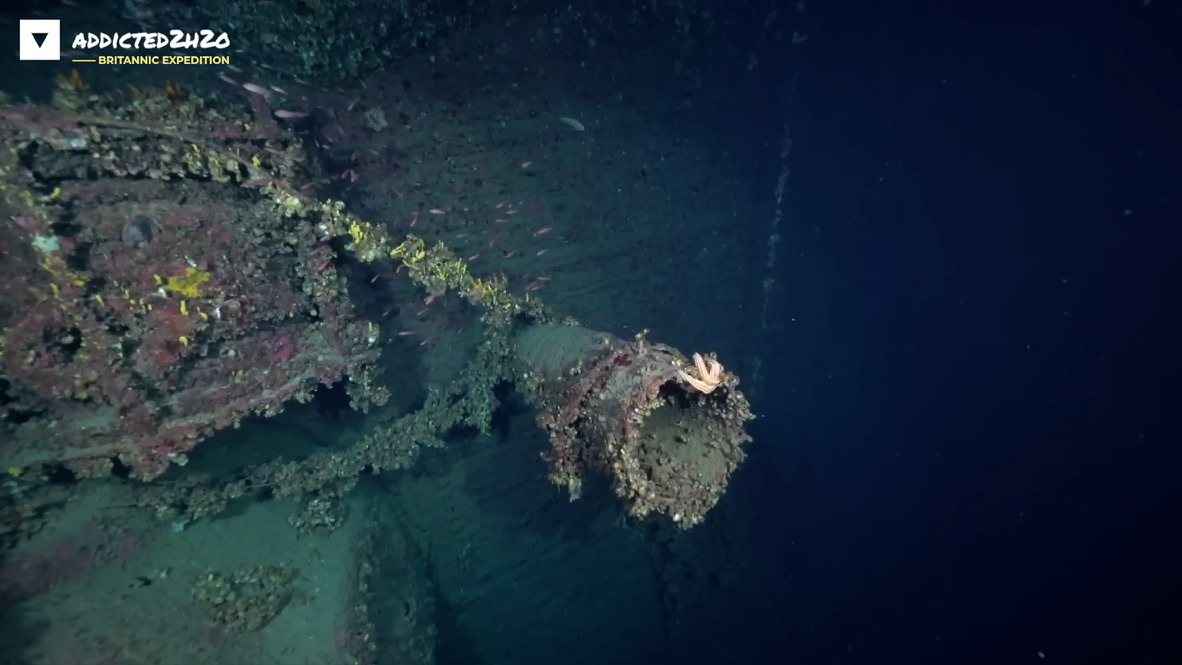
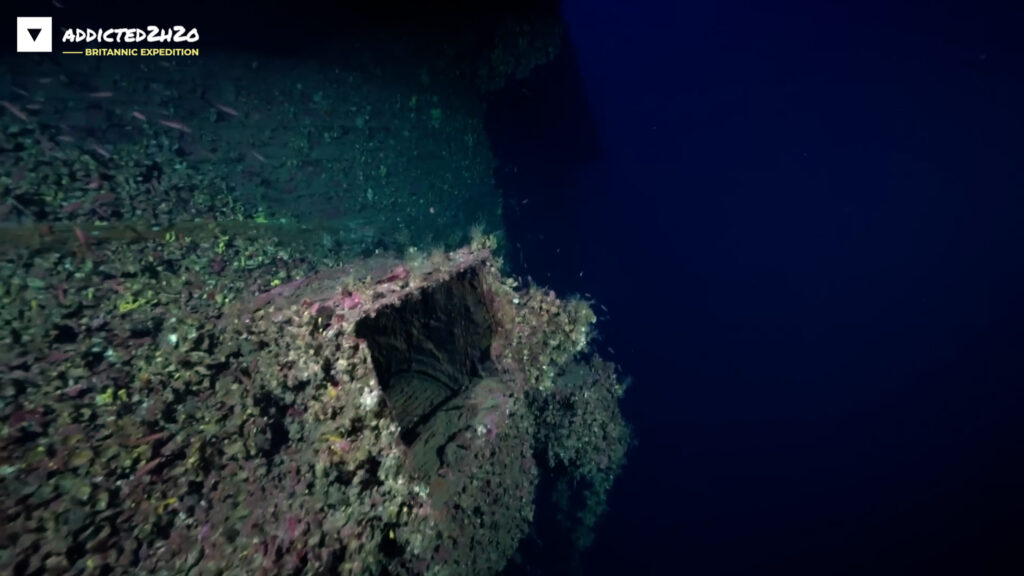
Near the bow, the great wound opens where the mine struck — a dark rift in the plating that tells the whole story in a single glance. The forward section shows the strain of the sinking, but much of the vessel remains coherent and legible: the hull, the decks, the vast superstructure lying on its side. For those trained and equipped to go inside, the interior still holds telegraphs, the helm, and the quiet, crushing scale of her machinery.
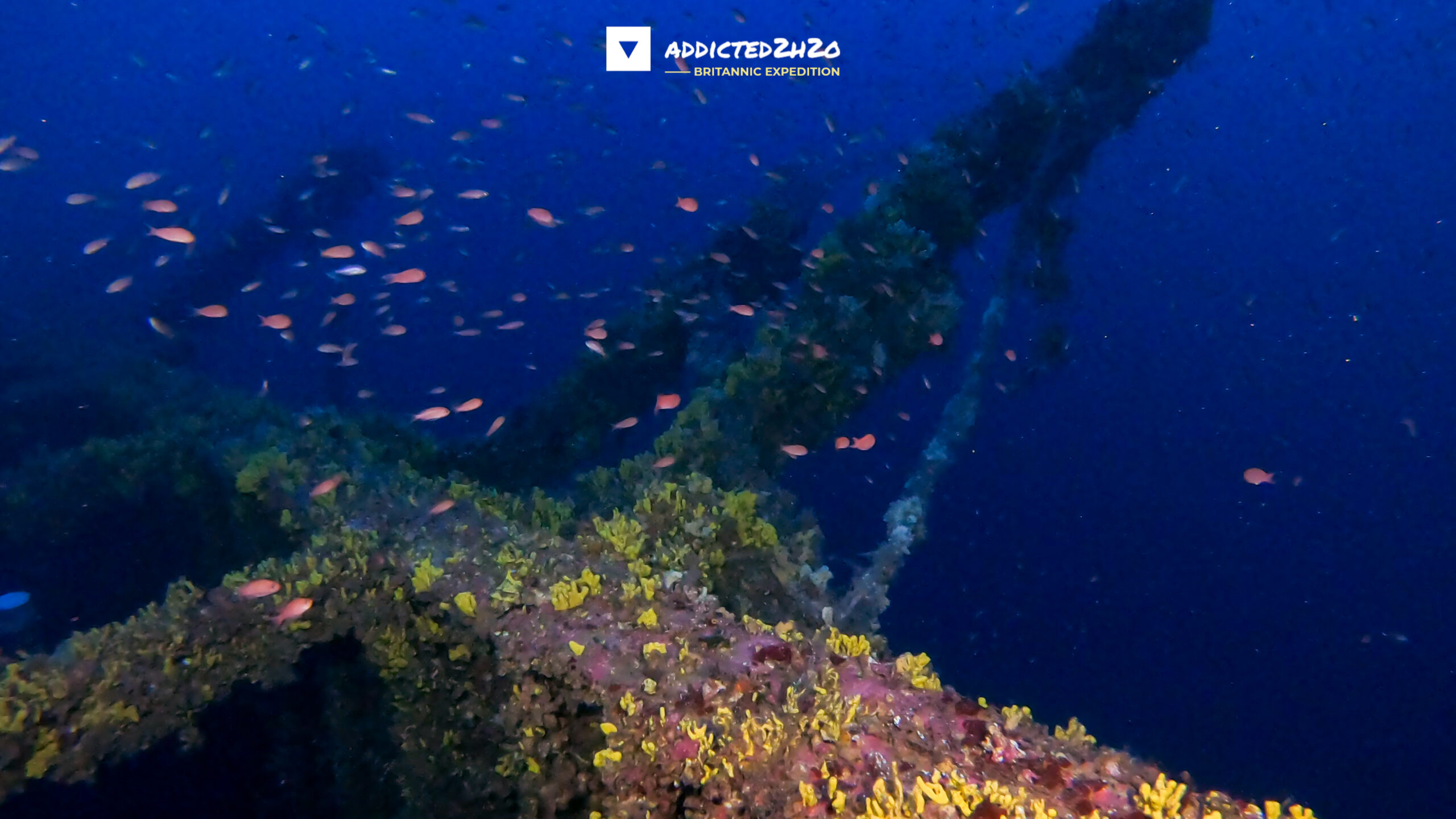
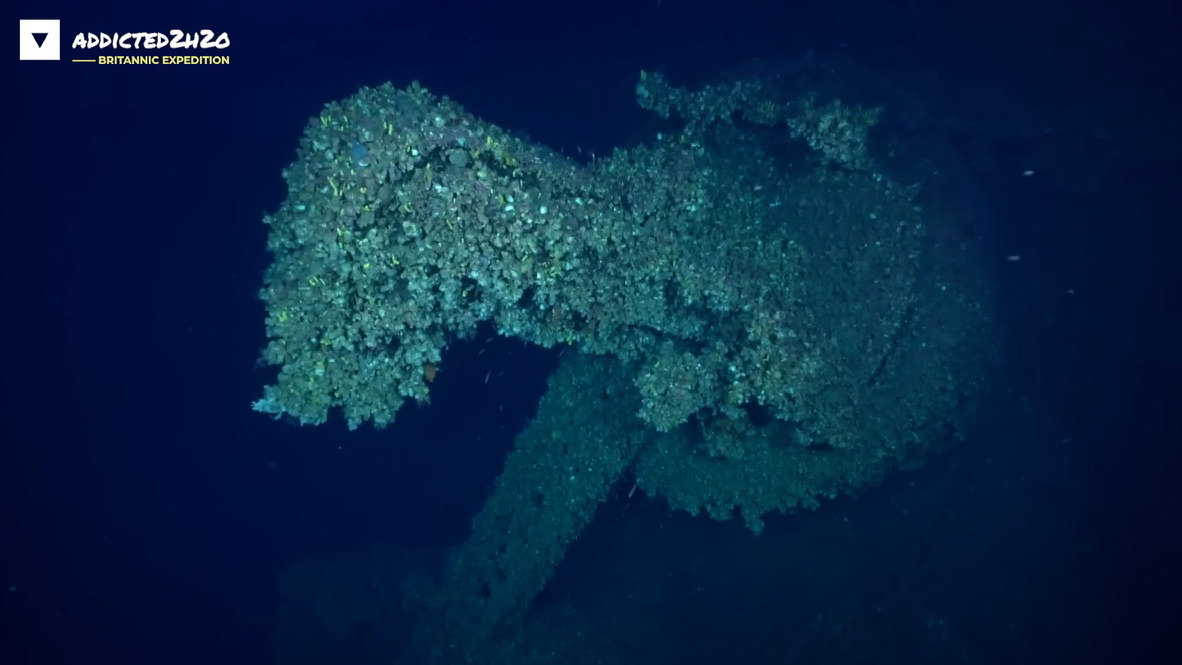
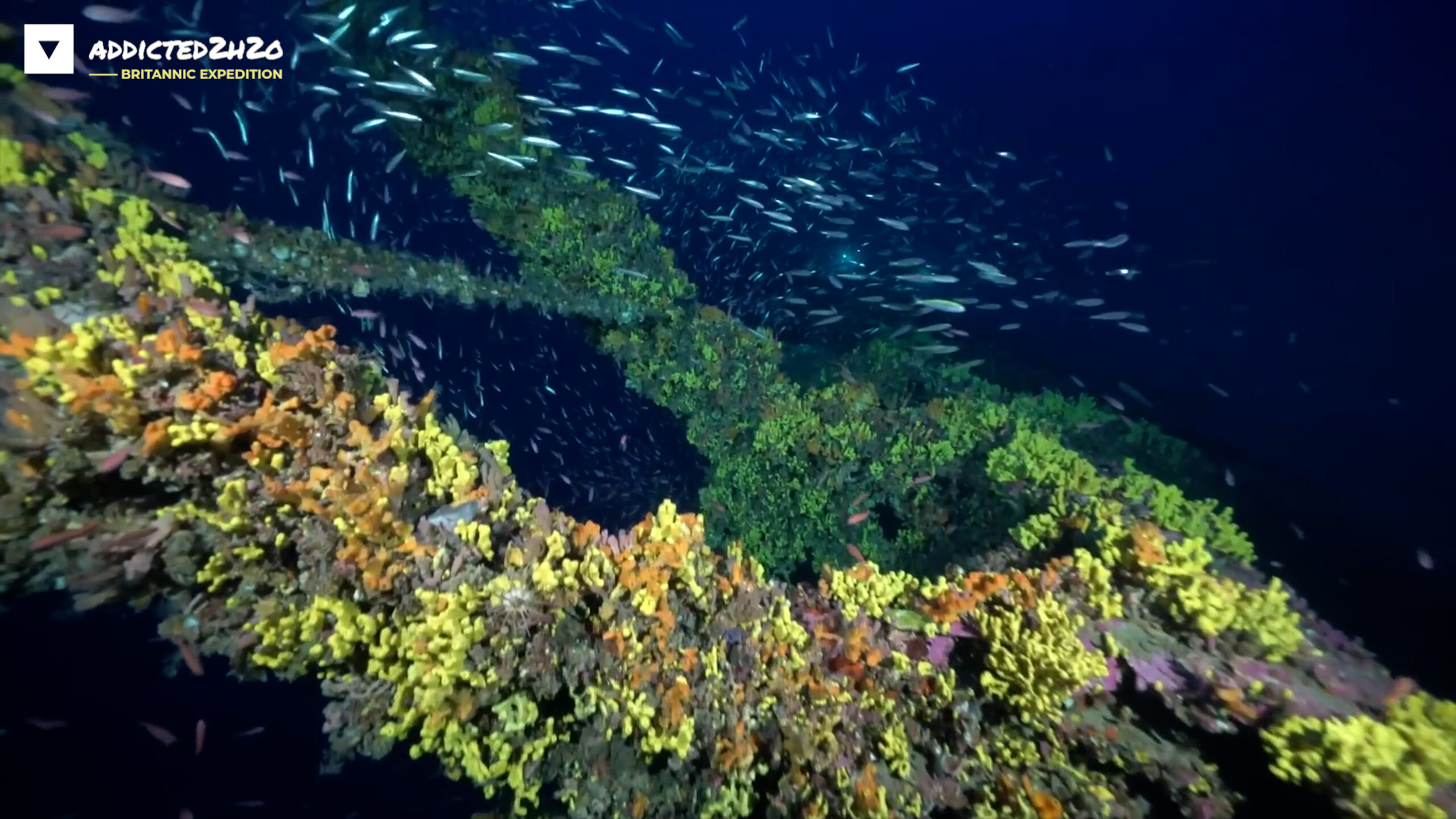
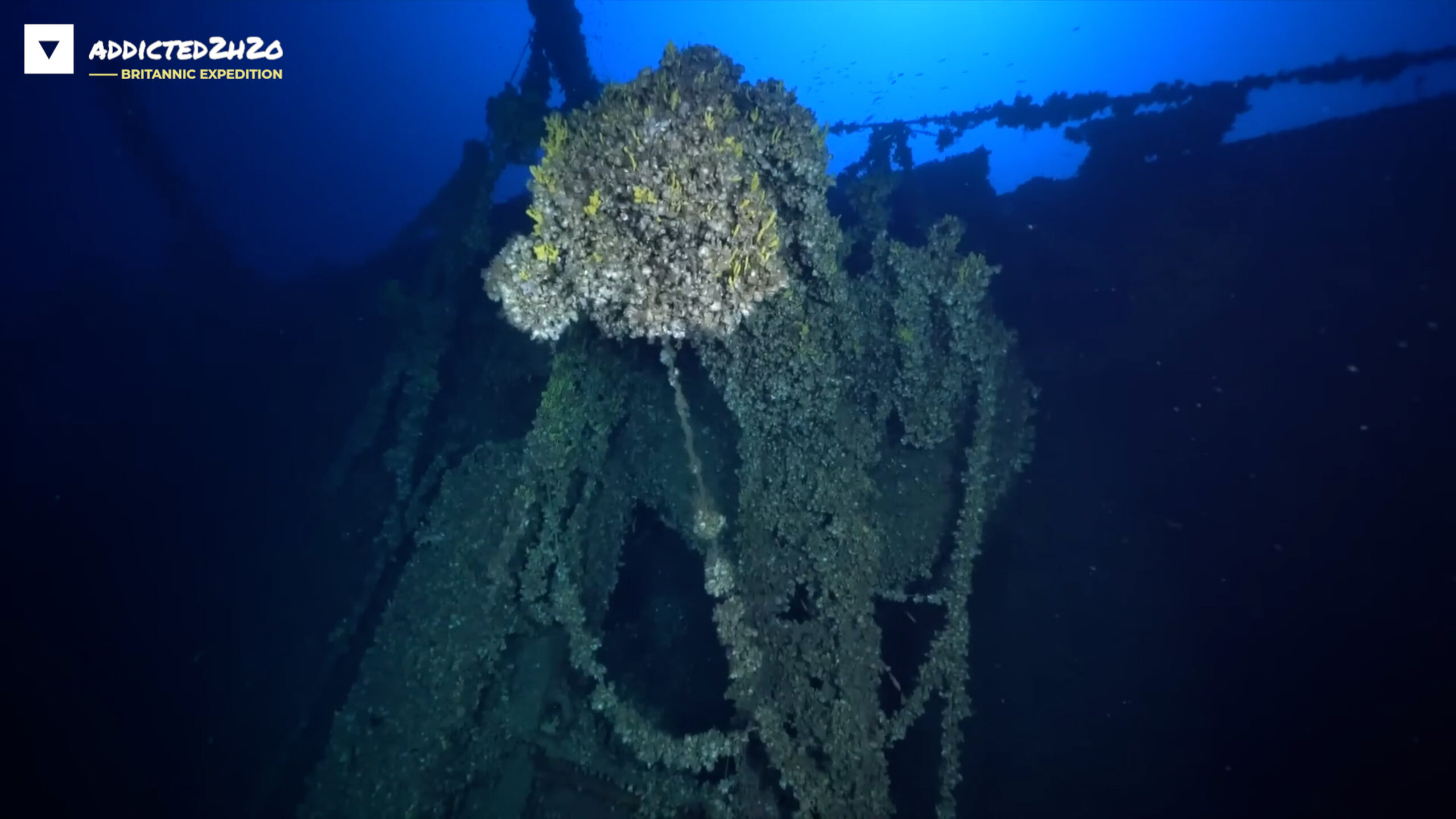
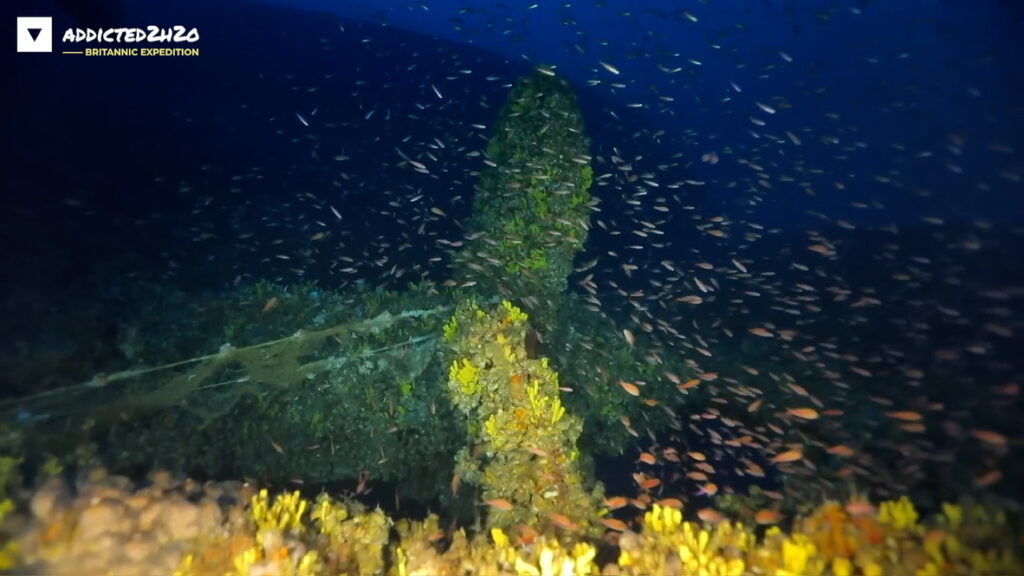
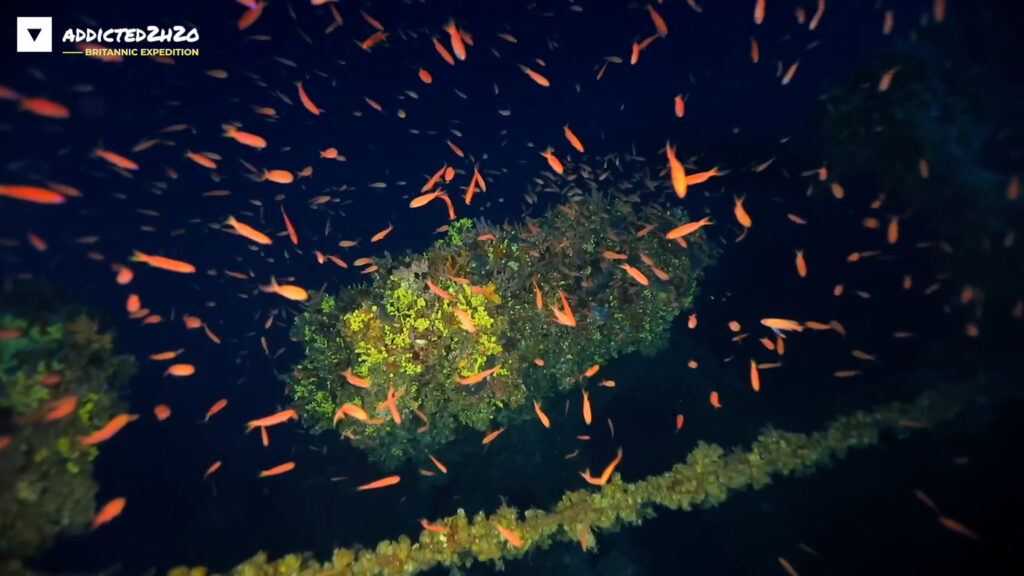
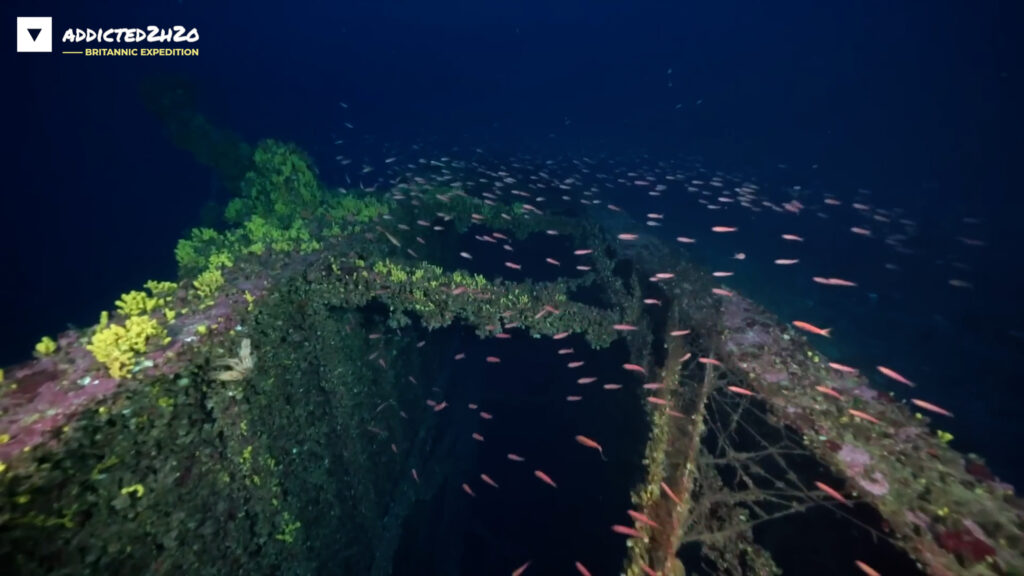
And then there is the stern, with the Britannic’s three great propellers — the two outer wing propellers each carrying three blades, the central one four — exactly as on the Titanic. Lying on her side as she is, the propellers are stacked rather than level: the uppermost reaches up toward roughly 105 meters, the shallowest of the three, while its twin is buried toward the seabed below. Today the blades are furred with green turf and studded with bright yellow sponges, hung here and there with the ghostly drape of lost fishing nets, and wrapped always in a living storm of fish. The shallowest point of the wreck is the upturned port side of the hull, which rises to around 84 meters. It is an entire world down there, grown over an engine of war and a monument to loss.
The Everest of diving
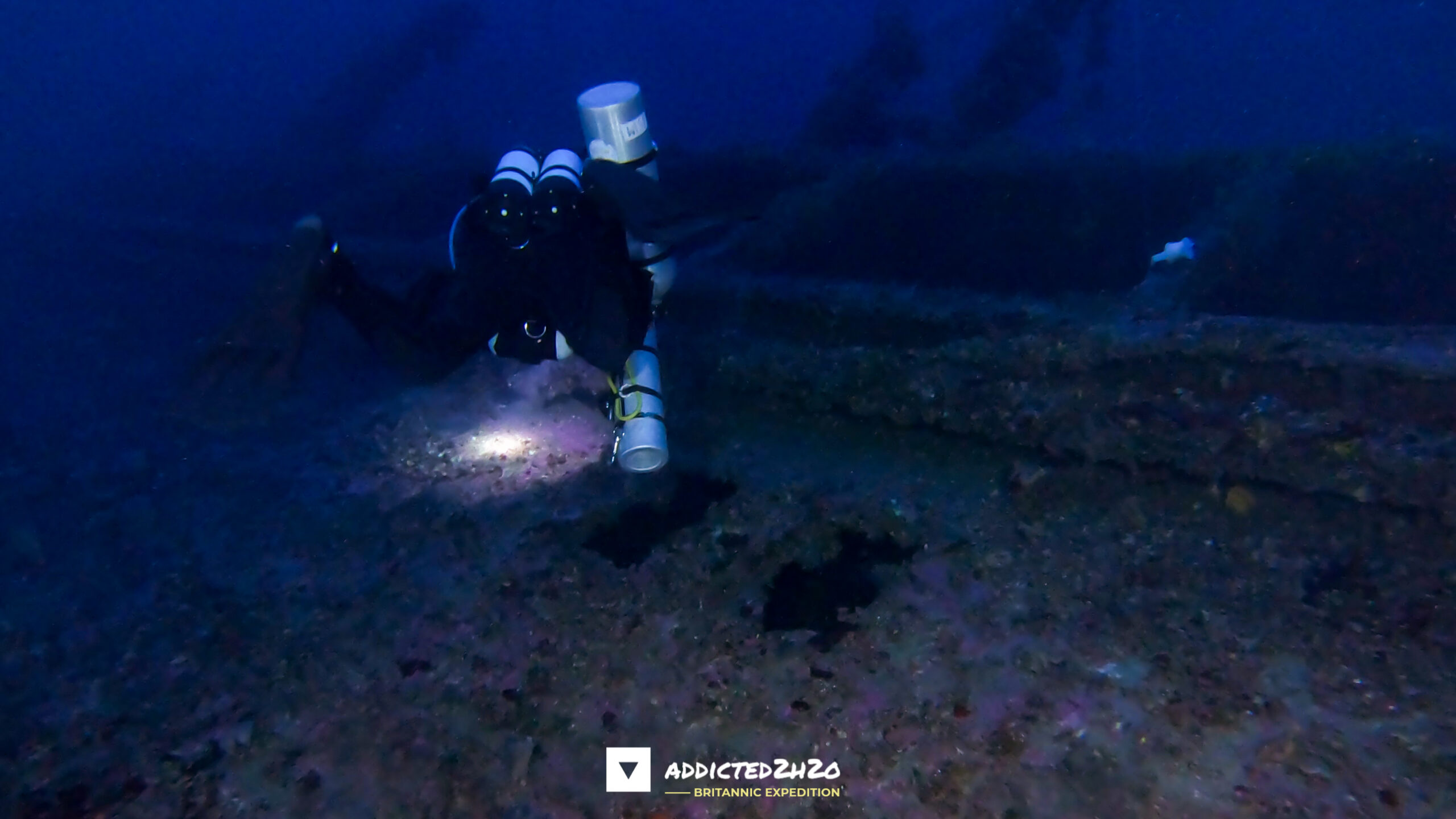
Divers call the Britannic the Everest of diving, and the comparison is earned. At 120 meters she sits far beyond the reach of recreational scuba, deep in the realm of hypoxic trimix and closed-circuit rebreathers. Breathing ordinary air at that depth would be lethal; the gas in our loops is carefully blended so that it can be breathed at all. Bottom time is measured in a handful of minutes, and the price of those minutes is hours of slow, disciplined decompression on the way back up.
Everything about the site raises the stakes. The Kea Channel is famous for strong and unpredictable currents that can turn a dive on its head without warning. The water is cold, and colder still during the long decompression hangs. There is almost no ambient light at depth, so the wreck reveals itself only in the beams we carry and gives up her true scale grudgingly, a section at a time. Planning is relentless: gas for the dive and gas for every imaginable failure, bailout strategy, team protocols, contingencies stacked upon contingencies. Nothing about the Britannic is casual.
She is, in short, a dive for the few — one that demands the right training, the right equipment, a capable team and a great deal of patience and preparation to reach at all. That is precisely what makes standing before her propellers, after everything, feel less like a dive and more like an audience granted.
Our Expedition
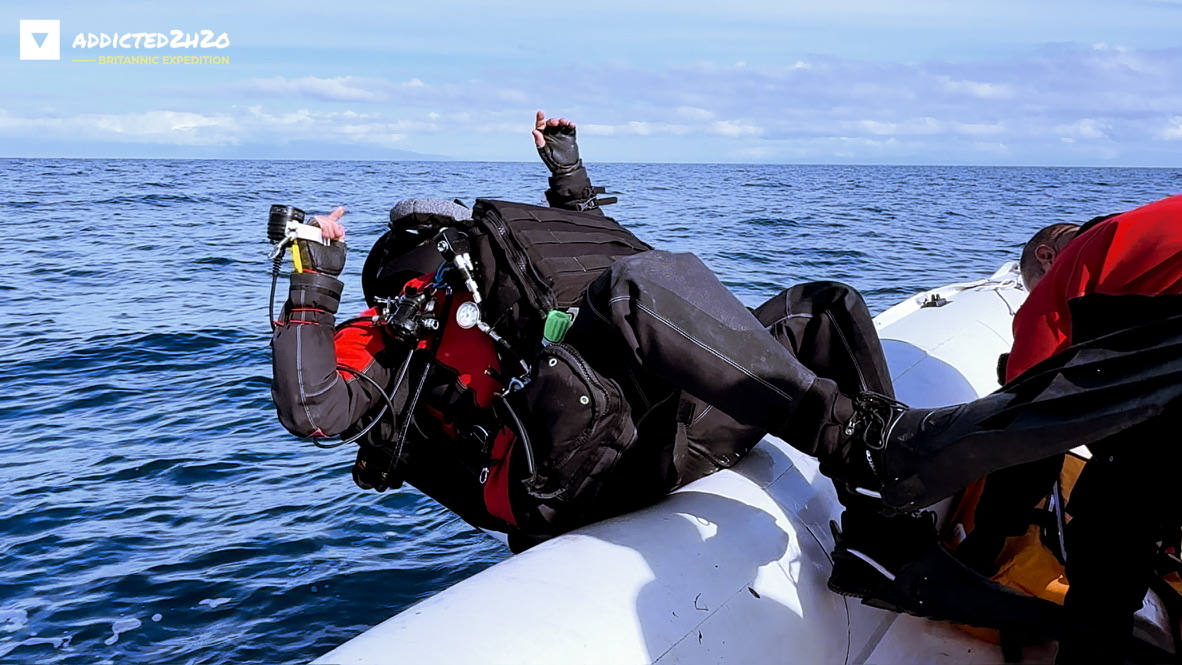
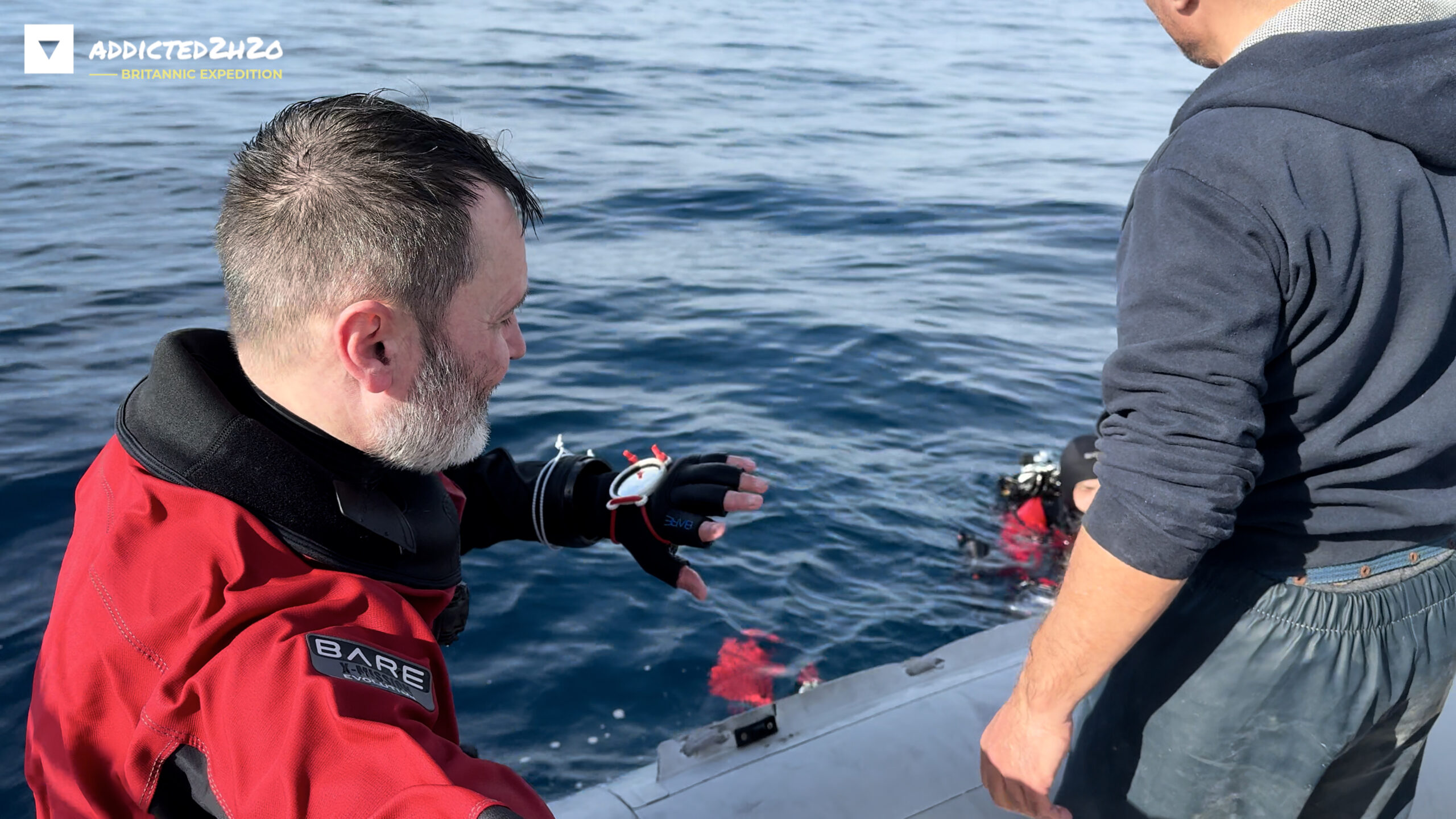
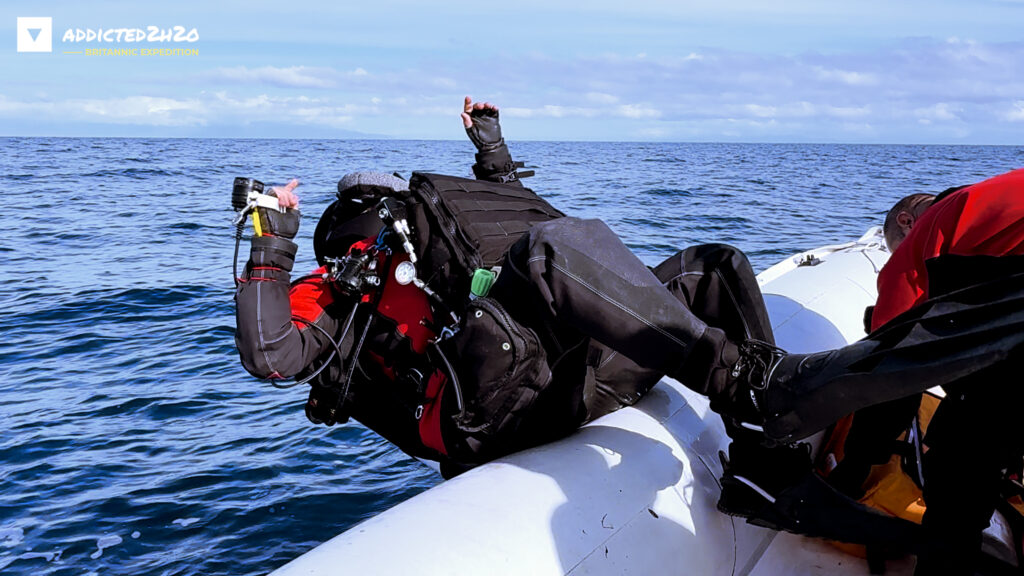
For us, the Britannic had been a dream long before it was a dive — the kind of objective you talk about in hushed terms for years, half-believing you will ever actually stand over her. The planning was months in the making: the training, the gas, the logistics of reaching the Kea Channel, the long conversations about everything that could go wrong and how we would answer it. When the day finally came and the shot line led us down into that darkening blue, the dream and the reality met somewhere around a hundred meters, and the ship simply appeared.
What stays with you is not any single feature but the silence and the scale. You move along a hull so long it has no visible end, past a rift where a war reached in and ended her, over decks that once carried the wounded home. At the stern, one of the great wing propellers rises out of the dark, its blade overgrown and alive, a ghost net snagged across it and a curtain of anthias shimmering around the whole thing. You hover there, weightless, breathing slowly, acutely aware that you are one of only a handful of people who will ever see this with their own eyes.
We came to document her — stills and video to carry back some fraction of what it feels like to be down there — and this is the first chapter of that work. The footage and photographs on this page were made over the course of our expedition, and they capture, at best, a sliver of the Silent Giant. The project is still ongoing. She has more to show us, and we intend to go back.
The Silent Giant
The Britannic was built for a world of ocean crossings and first-class promenades, and she never saw a day of it. She was dressed instead in white and red crosses, sent to carry the broken men of a war, and lost in under an hour to a weapon she never saw coming. More than a thousand people lived because her builders had learned, too late for her sister, to put enough boats on a ship. Thirty did not, and the sea remembers them.
Now she lies in the Aegean dark, grown over with turf and sponge and the ceaseless movement of fish, visited by only the very few. To dive her is to be humbled twice — once by the depth, and once by the history. She asks everything of you and gives back something that is difficult to put into words: a sense of standing, for a few borrowed minutes, inside a story far larger than yourself.
She is the largest intact liner on the floor of any ocean, and she is almost entirely forgotten. We think she deserves to be remembered. That is why we went, and why we will go again.
Powerful. Humbling. Unreal.
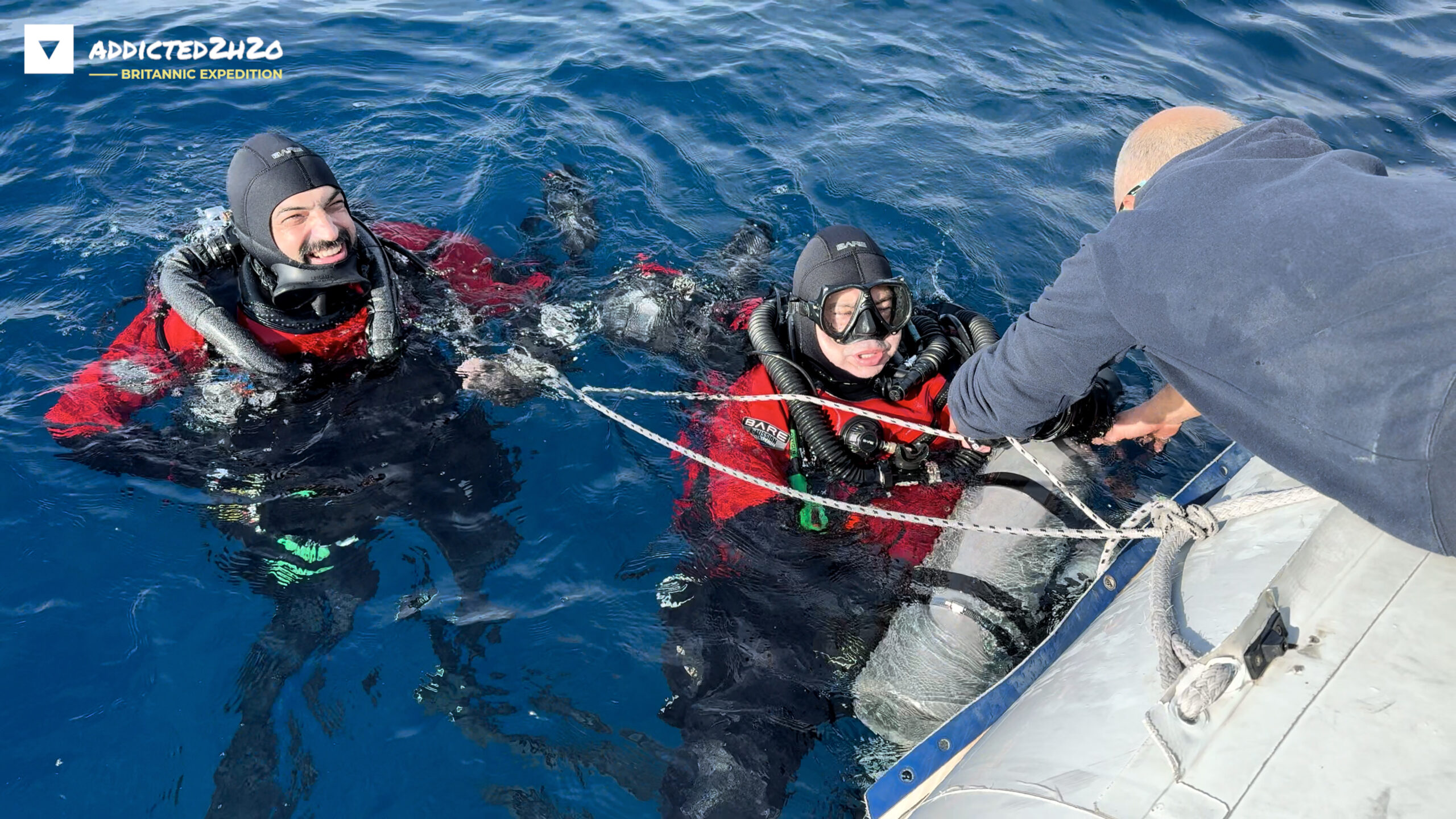
Divers:
Erikos Kranidiotis
Stelios Stamatakis
Ioannis Simiridis
Boat Captain:
Andonis Grafas
Do what you can’t
 English
  Greek
Greek